
Blog

Brake Repair in Upper Marlboro: Warning Signs, Typical Costs & What Our Ford Techs Check

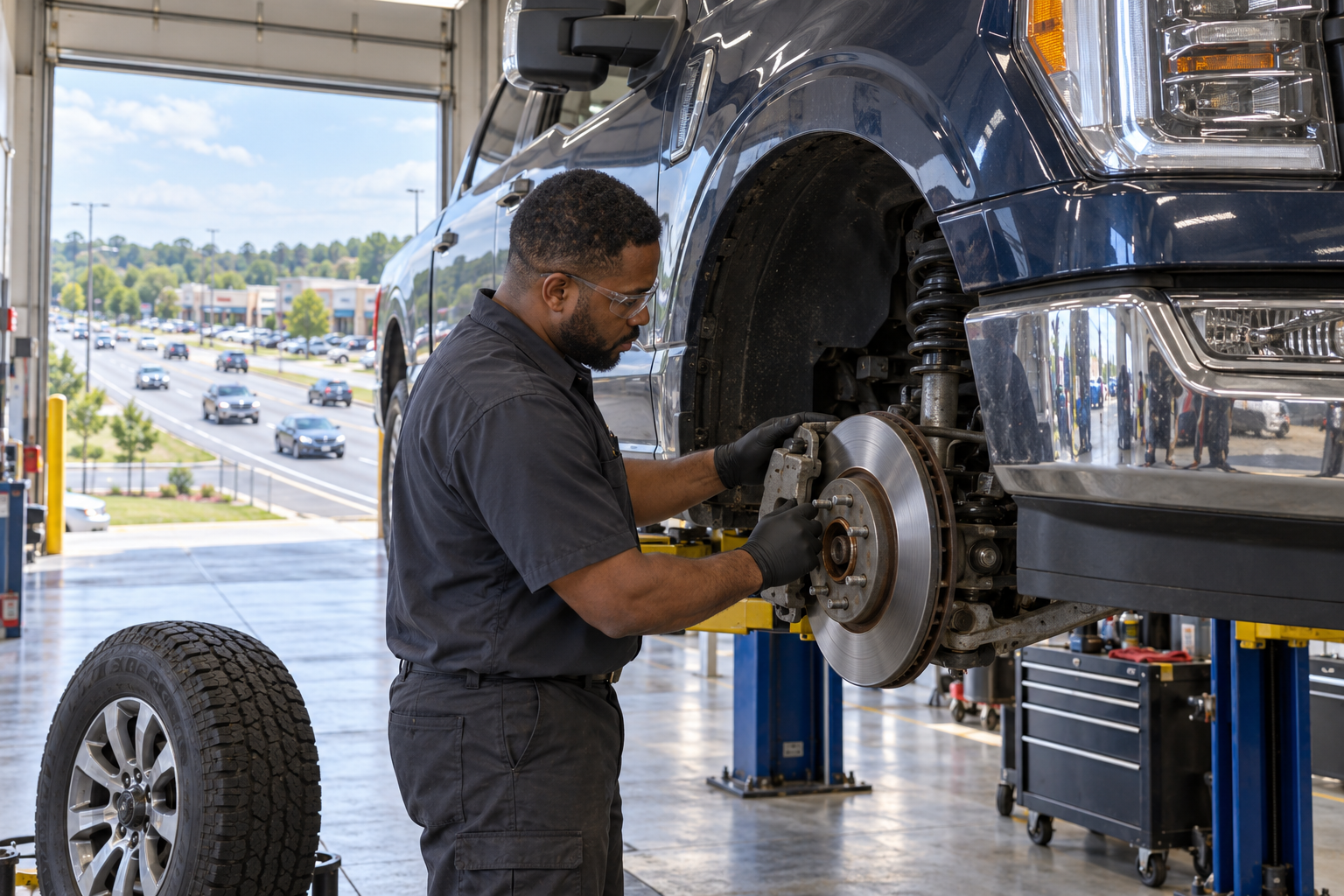
Technician inspecting brakes

Your brakes are the most important safety system on your vehicle. If you're searching for brake repair near me, you want a shop that finds the real problem, explains it clearly and gets you back on the road. At Upper Marlboro Ford, our Ford technicians handle brake repair in Upper Marlboro for drivers from Bowie, Clinton, Largo and across Prince George's County.

Ready now? Book a brake inspection online or call 301-417-5364.
Below, we cover the warning signs to watch for, the difference between pads and rotors, what brake work typically costs, and what our techs check.


6 warning signs your brakes need service

Brakes wear a little every time you stop, so changes can creep up on you. AAA and Kelley Blue Book point to these common signs:
  1. Squealing or squeaking. Many brake pads have a small metal tab that squeals when the pad gets thin. It's a built-in reminder to get them checked.
  2. Grinding. A harsh grinding or scraping sound can mean the pads are worn down to metal. That can damage the rotors fast, so don't wait.
  3. Shaking or a pulsating pedal. If the steering wheel shakes or the brake pedal pulses when you stop, your rotors may be worn or uneven.
  4. Longer stops. If it takes more distance to stop than it used to, or the pedal feels soft, have the system checked right away.
  5. Pulling to one side. A vehicle that pulls left or right when you brake may have a stuck caliper, uneven pad wear or a fluid issue.
  6. A puddle of brake fluid. A small, wet spot near a wheel or under the engine bay can mean a leak. Brake fluid is key to stopping power.
Also watch your dashboard. Many newer vehicles have a warning light that comes on when the brake pads wear down. If you see any of these signs, book a brake inspection soon. If the pedal goes to the floor or the car won't stop well, don't drive it. Call us for help.


Brake pads vs. rotors: what's the difference?

Your brake system has a few main parts that work together:
  • Brake pads press against the rotors to slow your wheels. They are built to wear out and be replaced.
  • Rotors are the metal discs the pads squeeze. They wear more slowly but can get thin, grooved or warped.
  • Calipers hold the pads and squeeze them when you press the pedal.
  • Brake fluid carries the force from your foot to the calipers.
According to Kelley Blue Book, brake pads usually last 25,000 to 50,000 miles, or about 2 to 5 years. How you drive matters a lot. Stop-and-go traffic on Route 301 or the Beltway wears pads faster than open highway miles. Towing and hauling do too.
Rotors don't always need to be replaced with pads. Our techs measure them and tell you if they are still in spec.


What brake repair typically costs

Brake costs depend on your vehicle, the parts it needs and how worn things are. Here are national estimates as of September 2026, from RepairPal and ConsumerAffairs:
Brake jobNational estimate
Brake pad replacement (average vehicle)$335–$394
Brake pad replacement (Ford F-150)$244–$301
Brake rotor replacement$574–$698
Pads and rotors, per axle$901–$1,084
These are national ranges, not our prices. Your cost may be higher or lower. The best way to know is to get a quote after a brake inspection. Pricing changes; see current offers at Upper Marlboro Ford on our service and parts specials page.

Catching worn pads early can help you avoid paying for rotors too. That's one more reason not to wait when you hear squealing.


How long does brake repair take?

The time depends on what your vehicle needs and whether parts are in stock. Ask when you book, and your service advisor can give you a time estimate.

What our Ford techs check

When you bring your Ford in for brake service, our techs take a close look at the whole system. A brake inspection typically includes:
  • Pads: thickness and how evenly they're wearing
  • Rotors: thickness, surface condition and signs of warping
  • Calipers: smooth movement and no sticking or leaks
  • Brake fluid: level and condition
  • Brake lines and hoses: cracks, leaks or damage
  • Test drive: how the brakes feel and sound on the road

We'll show you what we find and explain your options before any work starts. You decide what to do.
For Ford brake repair, we recommend Motorcraft brake pads. Motorcraft pads use friction formulas designed for each specific vehicle. Learn more on our Ford brake service page.

Brake service for Bowie, Clinton, Largo and Prince George's County

We're at 5701 Crain Highway in Upper Marlboro. That's a convenient stop for drivers in Bowie, Clinton, Largo and all of Prince George's County. If you're comparing brake shops near me, look for trained techs, clear quotes and parts made for your vehicle. That's what we aim to deliver. Whether you drive an F-150 to job sites or an SUV on the school run, our promise holds: Every Road. Every Family. One Ford Dealership.
Service hours are Monday through Friday, 7:30 a.m. to 6 p.m., and Saturday, 8 a.m. to 2 p.m.


Frequently asked questions

How do I know if I need new brake pads? Listen for squealing or grinding and watch for a brake warning light on your dash. A shaking wheel, a pulsating pedal or longer stops are also signs. A brake inspection will tell you for sure.
How much does brake pad replacement cost? RepairPal estimates brake pad replacement at $335 to $394 as a national average as of September 2026. For a Ford F-150, the estimate is $244 to $301. Your price depends on your vehicle, so ask us for a quote.
How long do brake pads last? Kelley Blue Book says brake pads usually last 25,000 to 50,000 miles, or 2 to 5 years. Heavy traffic, towing and hard stops wear them faster.
Do I always need new rotors with new pads? No. Our techs measure your rotors during the inspection. If they are still in good shape, you may only need pads.
Can I get brake repair the same day? It depends on what your vehicle needs and parts on hand. Ask when you book and we'll give you a time estimate.


Book your brake inspection in Upper Marlboro

Don't put off squealing, grinding or a soft pedal. Schedule your brake inspection online or call Upper Marlboro Ford at 301-417-5364. We're at 5701 Crain Highway, Upper Marlboro, MD 20772, and we're ready to help keep your family safe on every road.

Recommended Posts

Tacoma Limited

Toyota Tacoma Towing Capacity by Trim (2026): Full Chart + What You Can Actually Tow

The 2026 Toyota Tacoma towing capacity tops out at 6,500 pounds when properly equipped, and payload reaches up to 1,705 pounds, according to Toyota. The hybrid i-FORCE MAX models are rated lower, at up to 6,000 pounds in Toyota's launch materials. Your exact number depends on trim, cab, bed, drivetrain and powertrain, so this guide breaks it down and shows how to check what your truck can really pull. At Waldorf Toyota, we get this question every week from drivers in Waldorf, La Plata, St. Charles and Upper Marlboro. Some want to pull a fishing boat to the Potomac. Others want a small camper for a weekend away. Here is the plain answer. Toyota Tacoma towing capacity at a glance Maximum towing: up to 6,500 lbs (2026 Tacoma, properly equipped) Maximum payload: up to 1,705 lbs Where the 6,500-lb rating lives: Toyota's launch materials put it on SR5 i-FORCE and TRD PreRunner XtraCab grades i-FORCE MAX hybrid: up to 6,000 lbs [CONFIRM: 2026 i-FORCE MAX tow rating] New for 2026: a tow hitch is now standard on SR XtraCab models Two powertrains, two towing ceilings Every 2026 Tacoma uses a 2.4-liter turbocharged four-cylinder. The difference is whether a hybrid motor helps it. Powertrain Output Transmission Max towing i-FORCE 2.4L turbo Up to 278 hp, 317 lb-ft 8-speed automatic, or 6-speed manual on select models Up to 6,500 lbs i-FORCE MAX hybrid 326 hp, 465 lb-ft 8-speed automatic Up to 6,000 lbs The i-FORCE MAX makes much more torque, so it feels stronger pulling away from a stop or climbing a ramp. It is rated to tow a little less because the hybrid parts add weight. If your trailer stays well under 6,000 pounds, the hybrid's extra torque is a nice bonus. If you need every pound of rating, look at the i-FORCE trucks. 2026 Tacoma towing capacity by trim Toyota sells the 2026 Tacoma in eight trims. The table shows which powertrain each one uses, its starting MSRP and the most it can tow in its best setup. Trim Powertrain Starting MSRP Max towing (best setup) SR i-FORCE $32,145 SR5 i-FORCE $36,235 Up to 6,500 lbs TRD PreRunner i-FORCE $38,735 Up to 6,500 lbs TRD Sport i-FORCE or i-FORCE MAX $40,015 / $46,935 Up to 6,500 / 6,000 lbs* TRD Off-Road i-FORCE or i-FORCE MAX $42,415 / $47,235 Up to 6,500 / 6,000 lbs* Limited i-FORCE or i-FORCE MAX $53,170 / $56,495 Up to 6,500 / 6,000 lbs* Trailhunter i-FORCE MAX (standard) $63,350 Up to 6,000 lbs* TRD Pro i-FORCE MAX (standard) $64,350 Up to 6,000 lbs* *These are powertrain ceilings, not a promise for every truck. Cab style, bed length and 2WD or 4WD all change the final number. Starting MSRPs are for the 2026 model year as of September 2026 and do not include Toyota's delivery, processing and handling fee, taxes or options. Pricing changes; see current offers at Waldorf Toyota. Want the older numbers? Our earlier post, How Much Can the 2025 Toyota Tacoma Tow?, covers the 2025 lineup. What you can actually tow A tow rating is the most your Tacoma can pull in its best setup with a light load. Real life is heavier. Toyota notes that maximum towing is figured from the truck's base curb weight, plus cargo, people and equipment. Everything you add to the truck eats into what is left for the trailer. Here is how to check your own setup in four steps: Find your truck's exact rating. Look at the window sticker, the owner's manual, or ask us to pull it by VIN. Two Tacomas with the same trim name can have different ratings. Weigh the loaded trailer, not the empty one. A boat's weight on paper rarely includes fuel, gear, coolers and the trailer itself. Campers list a loaded weight limit on their own sticker. Add up payload. Passengers, bed cargo and the trailer's tongue weight all count against the truck's payload. A full cab and a loaded bed can use it up fast. Leave some room. Running right at the limit on hot days or long hills is hard on any truck. A trailer that lands comfortably under the rating will tow better and last longer. Toyota's own guidance is simple: never tow beyond published capacities, and confirm the truck and trailer are compatible, hooked up and loaded properly before you go. Common Southern Maryland loads We will not guess at your boat's weight, because hull, motor and trailer vary so much. Use the steps above with the real numbers from your trailer's paperwork. In general terms: Jet skis on a light trailer: usually an easy job for any Tacoma, even with gear in the bed. A small fishing or bay boat: a good match for most Tacomas, as long as you weigh the boat, motor, fuel and trailer together. A pop-up or compact travel trailer: possible on the right setup, but check loaded weight and payload carefully, especially with a family in the cab. A larger travel trailer or heavy boat: if your loaded weight is near or over the Tacoma's ceiling, look at a full-size truck. Our new inventory shows what is on the lot. Launching at a Potomac or Patuxent ramp? The i-FORCE MAX's low-end torque helps on a slick ramp, and 4WD helps even more. Get your Tacoma ready to tow Before a big trip, have your brakes, tires, cooling system and hitch wiring checked. Our service team can look the truck over and confirm your tow setup. Schedule service online and check our service and parts specials before you book. Frequently asked questions What is the maximum towing capacity of the 2026 Toyota Tacoma? Toyota rates the 2026 Tacoma to tow up to 6,500 pounds when properly equipped. Only certain i-FORCE configurations reach that number. Check your truck's sticker or ask us to look it up by VIN. Can the Tacoma hybrid tow? Yes. The i-FORCE MAX hybrid makes 326 horsepower and 465 lb-ft of torque and was rated up to 6,000 pounds in Toyota's launch materials. It tows slightly less than the top i-FORCE trucks because the hybrid parts add weight. How much payload does a Tacoma have? Toyota lists a maximum payload of up to 1,705 pounds for the 2026 Tacoma. Payload includes passengers, bed cargo and your trailer's tongue weight. The exact figure varies by trim and configuration. Does every 2026 Tacoma come with a tow hitch? For 2026, Toyota made the tow hitch standard on SR XtraCab models. Hitch equipment on other trims depends on the trim and packages. Ask us to confirm what a specific truck has before you buy. Find your Tacoma at Waldorf Toyota Ready to match a Tacoma to your boat or camper? Browse our new Tacoma inventory, then come see us at Waldorf Toyota, 2600 Crain Hwy, Waldorf, MD 20601. Call sales at 301-363-4046 or service at 301-238-5379. We serve drivers from Waldorf, La Plata, Bowie, Upper Marlboro and across Southern Maryland, and we will help you find the setup that tows what you actually own.

Upper Marlboro Ford F-150 Towing Camper

2026 Ford F-150 Towing Guide | Upper Marlboro Ford

Can a 2026 Ford F-150 Tow Your Boat, Camper, or Equipment Trailer? A truck’s maximum towing number only tells part of the story. The 2026 Ford F-150 can tow as much as 13,500 pounds when properly configured, but that does not mean every F-150 on the road can—or should—pull that much. Engine choice, cab style, bed length, axle ratio, equipment packages, passengers, and cargo can all change the towing capacity of an individual truck. For Maryland drivers, the right question is not simply, “How much can an F-150 tow?” It is, “Which F-150 configuration can safely handle what I plan to tow?” Whether you are pulling a fishing boat to the Chesapeake Bay, taking a camper across Maryland, or moving equipment between job sites in Prince George’s County, choosing the correct truck from the beginning can make towing safer, easier, and more comfortable. At Upper Marlboro Ford, we help truck buyers from Upper Marlboro, Bowie, Clinton, Waldorf, Annapolis, and throughout Southern Maryland match the truck to the actual trailer—not just the advertised maximum. Key Points About 2026 Ford F-150 Towing The 2026 Ford F-150 offers an available maximum towing capacity of 13,500 pounds when properly equipped. The available 3.5L EcoBoost V6 provides the highest maximum conventional towing capacity in the F-150 engine lineup. The 5.0L V8 can tow up to 12,800 pounds when properly configured. The available PowerBoost Full Hybrid V6 combines strong towing capability with onboard electrical power. Payload matters because trailer tongue weight, passengers, tools, and cargo all count against the truck’s available carrying capacity. The towing capacity of a specific F-150 should be confirmed before purchasing or connecting a trailer. 2026 Ford F-150 Towing Capacity by Engine The 2026 F-150 offers six engine choices, each built for a different balance of efficiency, power, towing, and everyday performance. 2026 F-150 engine Available maximum towing Available maximum payload 2.7L EcoBoost V6 8,400 lbs. 1,775 lbs. 3.5L EcoBoost V6 13,500 lbs. 2,440 lbs. 3.5L PowerBoost Full Hybrid V6 12,400 lbs. 1,740 lbs. 5.0L Ti-VCT V8 12,800 lbs. 2,235 lbs. High-Output 3.5L EcoBoost V6 8,200 lbs. 1,405 lbs. 5.2L Supercharged V8 8,700 lbs. 1,410 lbs. These are maximum available ratings, not the capacity of every truck with that engine. According to the official 2026 Ford F-150 Towing Guide, towing and payload vary based on configuration, options, accessories, passengers, and cargo. Which F-150 Engine Is Best for Towing? 3.5L EcoBoost V6: Best for Maximum Towing If towing capacity is your top priority, the available 3.5L EcoBoost V6 is the place to start. When paired with the required equipment and the right axle and body configuration, it can tow up to 13,500 pounds. This engine is a strong match for drivers who regularly pull: Larger travel trailers Enclosed equipment trailers Heavier boats Construction equipment Landscaping trailers Its 500 lb.-ft. of torque helps provide the low-speed pulling power drivers want when merging, climbing grades, or getting a heavy trailer moving. 5.0L V8: Traditional V8 Capability The available 5.0L V8 can tow as much as 12,800 pounds and carry an available maximum payload of 2,235 pounds when properly configured. It is a good fit for truck buyers who prefer traditional V8 power and want a truck that can manage substantial towing while also carrying tools, supplies, or recreational equipment in the bed. PowerBoost Full Hybrid V6: Towing Plus Mobile Power The available 3.5L PowerBoost Full Hybrid V6 can tow up to 12,400 pounds when properly equipped. It also offers available Pro Power Onboard, allowing the truck to supply electrical power for tools, equipment, camping accessories, or emergency needs. For a Maryland contractor, mobile business owner, or camper, that combination can be more valuable than simply choosing the engine with the highest towing number. 2.7L EcoBoost V6: A Practical Choice for Moderate Loads Not everyone needs maximum towing capacity. The available 2.7L EcoBoost V6 can tow up to 8,400 pounds when properly equipped, making it suitable for many boats, utility trailers, smaller campers, and recreational loads. It can also be a practical choice for owners who use their F-150 as a daily driver more often than they tow. Can an F-150 Tow a Boat? For many Maryland boat owners, yes. An appropriately equipped F-150 can handle a wide variety of fishing boats, center consoles, pontoons, and recreational boats. However, you need to calculate the complete loaded trailer weight, including: The boat The trailer Fuel Batteries Fishing equipment Coolers Safety gear Any other equipment stored aboard A boat advertised at 4,500 pounds may create a significantly heavier towing load once the trailer, fuel, and gear are included. The truck should be selected using the loaded towing weight, not the boat’s dry weight alone. Drivers launching around the Chesapeake Bay should also consider four-wheel drive, traction at wet ramps, trailer visibility, and the value of an integrated trailer brake controller. Can an F-150 Tow a Travel Trailer? The F-150 can tow many small, midsize, and some larger travel trailers, depending on the truck and trailer configurations. Travel trailers introduce an additional consideration: frontal area. A tall camper creates far more wind resistance than a low-profile utility trailer of the same weight. That added resistance can affect acceleration, fuel consumption, transmission behavior, and stability on highways. When shopping for a truck to pull a camper, consider: The camper’s loaded weight rather than its dry weight Trailer tongue weight Passengers and cargo carried in the truck Hitch and weight-distribution equipment The trailer’s height and frontal area How frequently and how far you plan to tow A truck that technically has enough capacity may still not be the most comfortable choice for frequent long-distance travel. Can an F-150 Tow an Equipment Trailer? The F-150 can be an excellent work truck for contractors, landscapers, property managers, and small business owners who pull moderate equipment loads. Depending on configuration, it may be capable of towing: Zero-turn mowers Compact tractors Small skid steers Landscaping equipment Building supplies Enclosed tool trailers Before choosing the truck, add the weight of the equipment to the trailer’s empty weight. Attachments, fuel, tools, and supplies also need to be included. If your loaded equipment trailer regularly approaches the upper end of the F-150’s capacity, an F-250 Super Duty may provide greater payload, stability, and room for future business growth. Why Payload Is Just as Important as Towing Capacity Payload is one of the most commonly overlooked parts of choosing a tow vehicle. Trailer tongue weight presses down on the hitch and counts against the truck’s available payload. Passengers, tools, cargo, aftermarket accessories, and anything stored in the bed count against it too. Imagine a trailer with 900 pounds of tongue weight. Add four passengers, a bed-mounted toolbox, and several hundred pounds of equipment, and the truck may reach its payload limit even if the trailer remains below the advertised towing capacity. The payload rating for an individual truck can be found on the label inside the driver’s doorjamb. That vehicle-specific number is more useful than a general maximum advertised for the model line. What Equipment Does an F-150 Need for Towing? Depending on the trailer and truck configuration, useful or required towing equipment may include: Tow/Haul Package Available Max Tow Axle Integrated trailer brake controller Smart Trailer Tow Connector Trailer Sway Control Pro Trailer Backup Assist Pro Trailer Hitch Assist Weight-distributing hitch Four-wheel drive Properly rated hitch ball and mounting equipment For trailers weighing more than 5,000 pounds, Ford specifies the use of a weight-distribution system. Trucks approaching the highest available towing ratings also require particular factory equipment and axle configurations. This is why two F-150s that look nearly identical can have very different towing limits. Five Questions to Answer Before Choosing Your F-150 Before selecting a truck, answer these questions: What is the trailer’s fully loaded weight? How much tongue weight will the trailer place on the truck? How many people, tools, and supplies will normally ride in the truck? Will you tow occasionally around town or regularly at highway speeds? Could you purchase a larger trailer or heavier equipment in the next few years? If you are close to the truck’s limits before adding passengers or cargo, moving to a higher-capacity configuration—or stepping up to an F-250—may be the better long-term decision. A Final Word on Choosing an F-150 for Towing The 2026 Ford F-150 offers enough variety to handle everything from weekend trips to demanding workdays. But choosing the right truck requires more than finding the engine with the largest number beside it. A properly matched truck should have enough towing and payload capacity for the loaded trailer, passengers, cargo, and equipment—with room left for real-world use. At Upper Marlboro Ford, our team can help you compare engines, cab and bed configurations, axle ratios, towing packages, payload ratings, and available technology. Bring us the specifications for your boat, camper, or equipment trailer, and we can help identify an F-150 built for the job. Visit Upper Marlboro Ford at 5701 Crain Highway in Upper Marlboro, Maryland, explore our available Ford F-150 inventory online, or contact our team to find a truck equipped for what you actually plan to tow. Maximum towing and payload ratings require specific vehicle configurations and equipment. Ratings vary based on accessories, options, cargo, passengers, and vehicle configuration. Always consult the vehicle’s labels, owner’s manual, and applicable Ford towing information before towing.

Silver Ford F-350 Super Duty (1)

Commercial vs. Non-Commercial Vehicle: Which Ford Work Truck Does Your Maryland Business Actually Need?

New Work Trucks Used Commercial Vehicles Contact Us Picking the wrong work truck costs Maryland small business owners more than they think. Not just at the register, but in taxes, downtime, and jobs they can't take on. The F-150, F-250, and Transit each sit in a different tax and regulatory tier depending on configuration. The F-250's available 10,000 lb. GVWR configuration is the sweet spot: full Section 179 eligibility, heavy-duty capability, and no FMCSA commercial vehicle requirements. The difference between these two categories can mean thousands of dollars in tax savings, or thousands in unnecessary costs if you choose wrong. At Upper Marlboro Ford, we've helped contractors, tradespeople, and small business owners across Prince George's County, Waldorf, Annapolis, and beyond find the right fit for their operation. Commercial vs. non-commercial vehicle classification for Maryland work trucks comes down to GVWR. Vehicles over 10,000 lbs. GVWR trigger FMCSA rules; vehicles over 6,000 lbs. may qualify for the full Section 179 tax deduction. The Ford F-250 Super Duty's available 10,000 lb. configuration threads both needles. Key Points: Commercial vs. Non-Commercial Vehicle GVWR determines classification. Work-use vehicles over 6,000lbs GVWR (Gross Vehicle Weight Rating) become eligible for Section 179 deduction. Some lighter vehicles may qualify, with limits. The F-250 Super Duty and Ford Transit are built for different jobs. Towing heavy loads and hauling enclosed cargo are not the same need. The F-250 maximizes both its weight class and your benefits. While the F-150, F-250, and Transit are all useful for work, the F-250 sits just under the threshold for stricter regulations while being a powerful work truck. What Makes a Vehicle "Commercial" in the First Place? In practical terms, a standard F-150 typically falls below the commercial threshold in most configurations, the F-250 Super Duty tends to be exactly at the threshold, and the Transit can land on either side depending on how it is spec'd. The word 'commercial' gets used loosely, but the federal government is precise about it. The Federal Motor Carrier Safety Administration defines a commercial motor vehicle as one used for business with a GVWR of 10,001 pounds or more. Cross that threshold in your operations, and your vehicle is subject to stricter insurance minimums, DOT compliance reviews, and potential CDL requirements if your total weight crosses 26,000 pounds. Keep in mind: regulatory oversight is triggered strictly by the vehicle's weight and business usage. For a plumber in Clinton or a landscaper running jobs between Bowie and Prince Frederick, understanding this line is the first step toward building a fleet that works legally and financially. How the IRS Sees It: Section 179 Deductions for Work Vehicles When it comes to Section 179, things are a bit different. IRS tax rules treat heavy vehicles between 6,001 and 14,000 lbs. generously, but they cap standard SUVs at $32,000 for 2026. However, your business can unlock the full, uncapped Section 179 deduction if the vehicle is built strictly for work. That includes cargo vans with no rear seats (like many Transits) and trucks with a bed at least 6 feet in interior length Heavy work trucks, cargo vans, and vehicles with cargo beds over six feet long may qualify for the full Section 179 deduction without the SUV cap limitation. For 2026, the maximum Section 179 deduction is $2,560,000, with a phase-out beginning above $4,090,000 in total qualifying purchases. Vehicles must be placed in service before December 31 and used for more than 50% of business activity to qualify. Bonus depreciation of up to 100% may also be available for qualifying property acquired after January 19, 2025, under IRS Notice 2026-11. This can be stacked on top of Section 179 to maximize first-year write-offs. Always consult a qualified tax advisor before making purchasing decisions based on deduction eligibility, as individual circumstances, business income, and applicable rates vary. F-250 Super Duty vs. Ford Transit: Picking the Right Tool Two vehicles dominate the conversation for Maryland contractors, and they serve very different masters. Here's how they compare side by side. Ford F-250 Super Duty Ford Transit Cargo Van Best For Towing, hauling, job site access Enclosed cargo, deliveries, mobile services Est. Max Towing Up to 23,000 lbs. (when properly equipped) Up to 6,900 lbs. (when properly equipped) Est. Max Payload Up to 4,246 lbs. (est., varies by config.) Up to 5,110 lbs. (est., varies by config.) GVWR 10,000–11,400 lbs. 8,670–11,000 lbs. Cargo Volume Open bed Up to 536.4 cu. ft. Full Section 179 Qualifies (most configs.) Qualifies (most configs.) Who Needs It? General contractor, landscaper, equipment hauler Electrician, HVAC tech, delivery, mobile service The F-250 Super Duty is the right call when your work demands raw towing and hauling muscle. The 2025 F-250 is designed to tow up to 23,000 pounds and haul up to 4,246 pounds of payload when properly equipped, with power from four available V8 engine options. One critical point about the F-250 is that it can be configured to land exactly at 10,000 lbs., meaning you get full Section 179 benefits and maximize the truck’s output without triggering FMCSA regulations for a 10,001 lb. commercial vehicle. The Transit, on the other hand, is purpose-built for businesses that live out of their van. The 2025 Ford Transit Cargo Van offers cargo volume ranging from 280.9 cubic feet to 536.4 cubic feet depending on body style and roof height, making it a rolling workshop for tradespeople running routes across Southern Maryland. When Does an F-150 Make Sense for a Business? Not every Maryland business owner needs to step up to a Super Duty. The 2025 F-150 can tow up to 13,500 lbs. and carry an estimated maximum payload of 2,440 lbs. when properly configured, making it a capable choice for lighter commercial work. It sits below the FMCSA's commercial motor vehicle threshold in most configurations, which means no CDL requirements and simpler insurance. The F-150 can still qualify for a full Section 179 deduction in configurations that feature a GVWR over 6,000 lbs. and a standard bed length of 6.5 or 8 feet. That makes it a tax-efficient choice for sole proprietors, real estate professionals, or light-duty service businesses operating around Bowie, Annapolis, or Upper Marlboro. Overall, the F-150 is best suited for daily driving with added utility, while the F-250 Super Duty is built for professional contractors who regularly haul massive loads or tow large trailers. Five Questions to Ask Before You Buy Before you choose between the F-150, F-250, or Transit, answer these five questions. What is my typical load? Towing equipment trailers points to the F-250. Carrying tools and parts points to the Transit. Do I need enclosed cargo space? If yes, a pickup bed won't cut it. The Transit wins here. Am I crossing state lines regularly? Interstate commercial operation above the GVWR threshold triggers FMCSA rules, including logbooks and inspections. Do I want to maximize my Section 179 deduction before December 31? If yes, confirm your vehicle's GVWR and business-use percentage before you sign. Will I need to upfit this vehicle? Racks, shelving, and service bodies are easier to build into a Transit or a chassis cab from the start than to retrofit later. A Final Word on Choosing the Right Ford Work Truck Now that you know the difference between a commercial and non-commercial vehicle, the next step is matching that knowledge to the specific demands of your business before the end of the tax year. One thing worth emphasizing: the right truck is not always the biggest one. Total cost of ownership matters far more than the sticker price. Fuel costs, insurance premiums, maintenance intervals, and available service when something goes wrong all add up over five years. Ford Pro's nationwide service network is a real business continuity advantage, not just a selling point. For Maryland contractors who can't afford a truck sitting in a shop, knowing that a dealer's service team has your back is worth factoring into the decision. At Upper Marlboro Ford, our commercial vehicle team works with small business owners from Upper Marlboro, Waldorf, Annapolis, Clinton, Bowie, and Prince Frederick every day. We carry a full lineup of F-150, F-250 Super Duty, and Ford Transit Cargo Van configurations, and we can walk you through upfit options and business financing to get your fleet working for you. Come see us at 5701 Crain Hwy, Upper Marlboro, MD 20772, or visit us online at uppermarlboroford.com to explore our commercial vehicle inventory and connect with our team.